+86 18717921345
(Whatsapp/Wechat)
World-leading provider of boilers and industrial boiler solutions
 +86 18717921345|
 ht@hnhtgf.com|
- Language|

World-leading provider of boilers and industrial boiler solutions
+86 18717921345|ht@hnhtgf.com|
huatai boiler 2026-11-16 17
When budgeting at year-end, many factory owners and equipment managers ask the same question: Boiler fuel costs are currently too high. Will switching to a biomass boiler really save money? And how much can be saved? Today, we back our analysis with data and break down the numbers clearly.
To judge whether a boiler delivers savings, we cannot only look at the unit fuel price. The key metric is the cost to generate one ton of steam.
If local wood chips and agricultural & forestry residues are used as biomass feedstock, raw material costs can be further reduced, subject to transportation distance and feedstock availability. This table only calculates fuel costs, excluding expenses for environmental operation & maintenance, labor, warehousing, ash disposal, equipment depreciation and other overheads. The cost gap does not represent a fixed saving amount. The cost reduction benchmark is only valid under stable steam consumption, reliable fuel supply and properly matched boiler models.
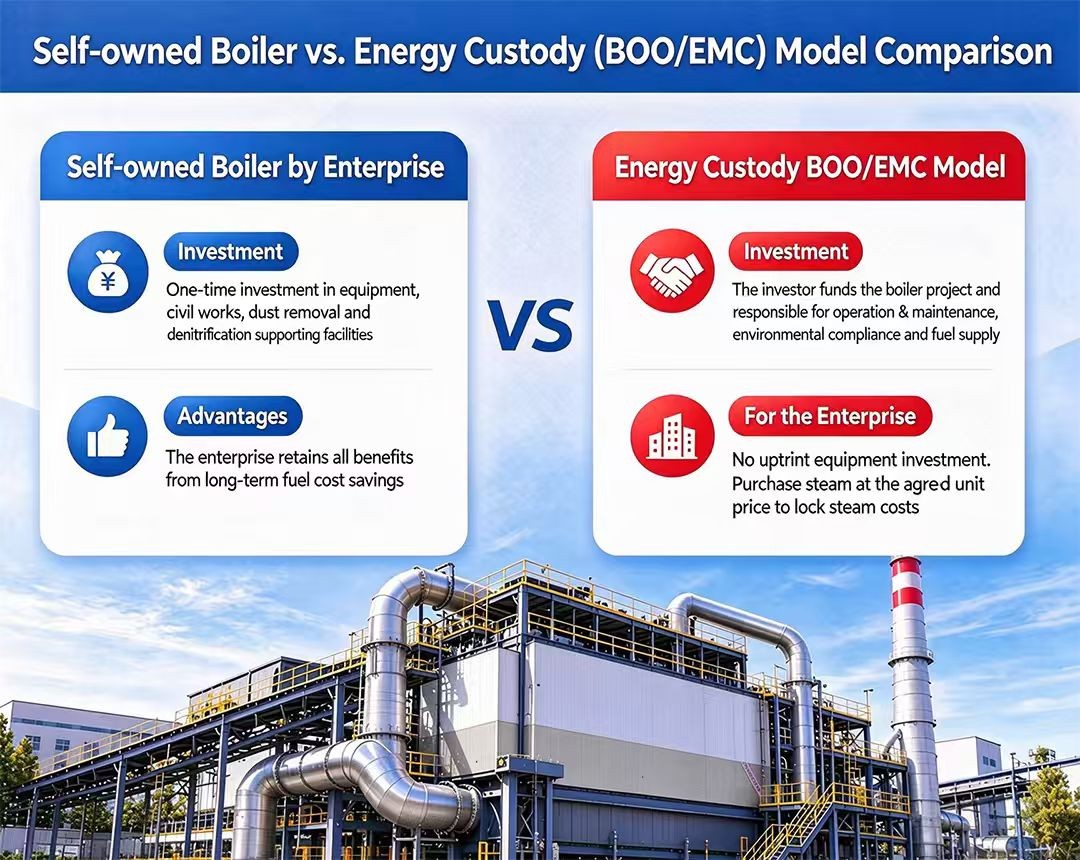
Many enterprises confuse two options: purchasing and installing boilers on their own, or adopting energy hosting models (BOO/EMC).
Enterprise-owned boiler: The enterprise bears upfront capital expenditure for equipment, civil works, and supporting dust removal and denitrification systems. The advantage is that the enterprise retains all long-term fuel cost benefits. It suits factories with stable steam demand, large annual steam consumption and stable access to biomass fuel. ⚠️ Hidden costs: fuel storage space, feeding labor, ash removal, routine maintenance, and environmental compliance management.
Energy Hosting (BOO/EMC): The investor funds the boiler system and takes charge of operation, environmental compliance and fuel supply. The enterprise simply purchases steam at an agreed unit price, with no upfront equipment investment. Steam prices are locked in to hedge against fuel price hikes, making this the preferred option for numerous factories at present.
Switching to a biomass boiler does not guarantee savings automatically. The actual saving potential depends on these conditions:
Stable fuel supply: long-term, reliable biomass feedstock sources
Suitable fuel calorific value: higher calorific value and lower moisture content lead to better combustion efficiency
High boiler efficiency: high-efficiency combustion and waste heat recovery can significantly cut fuel consumption
Stable steam load: volatile loads require more sophisticated operational management
Local gas and coal prices: regional energy prices affect the margin of savings
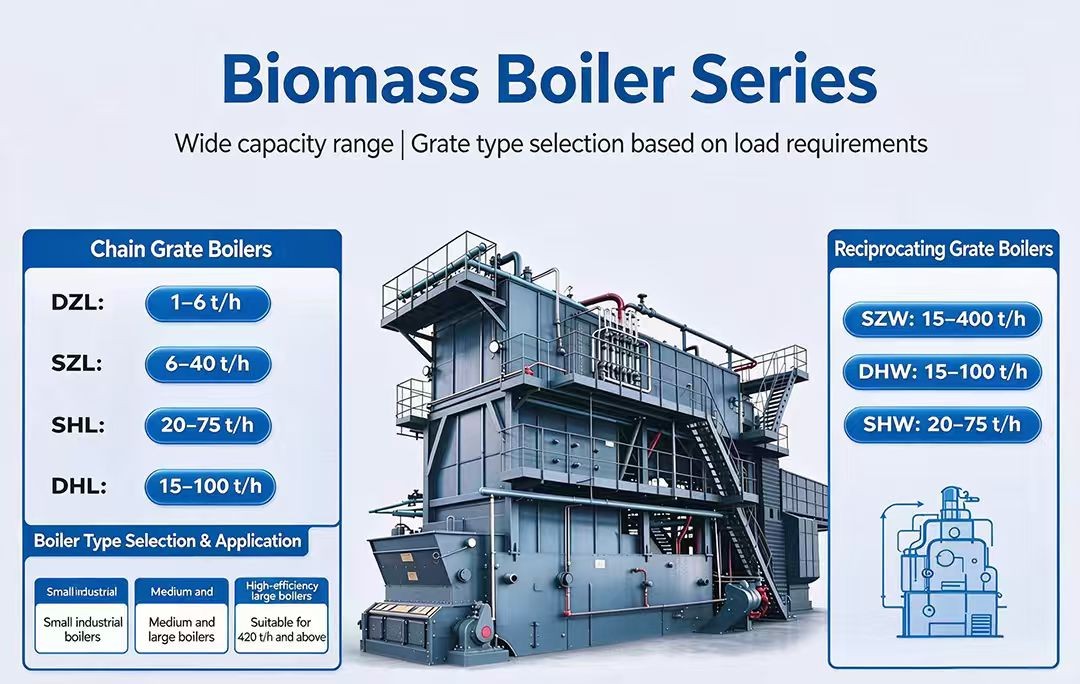
Huatai’s biomass boiler portfolio covers a wide capacity range:
DZL: 1–6 t/h
SZL: 6–40 t/h
SHL: 20–75 t/h
DHL: 15–100 t/h
Chain grates are available in multiple types: belt grates, large/small scale grates and beam grates.
Belt grates: generally for small boilers
Large/small scale grates: generally for boilers below 40 t/h
Beam grates: generally for large-capacity boilers above 40 t/h
SZW: 15–40 t/h
DHW: 15–100 t/h
SHW: 20–75 t/h
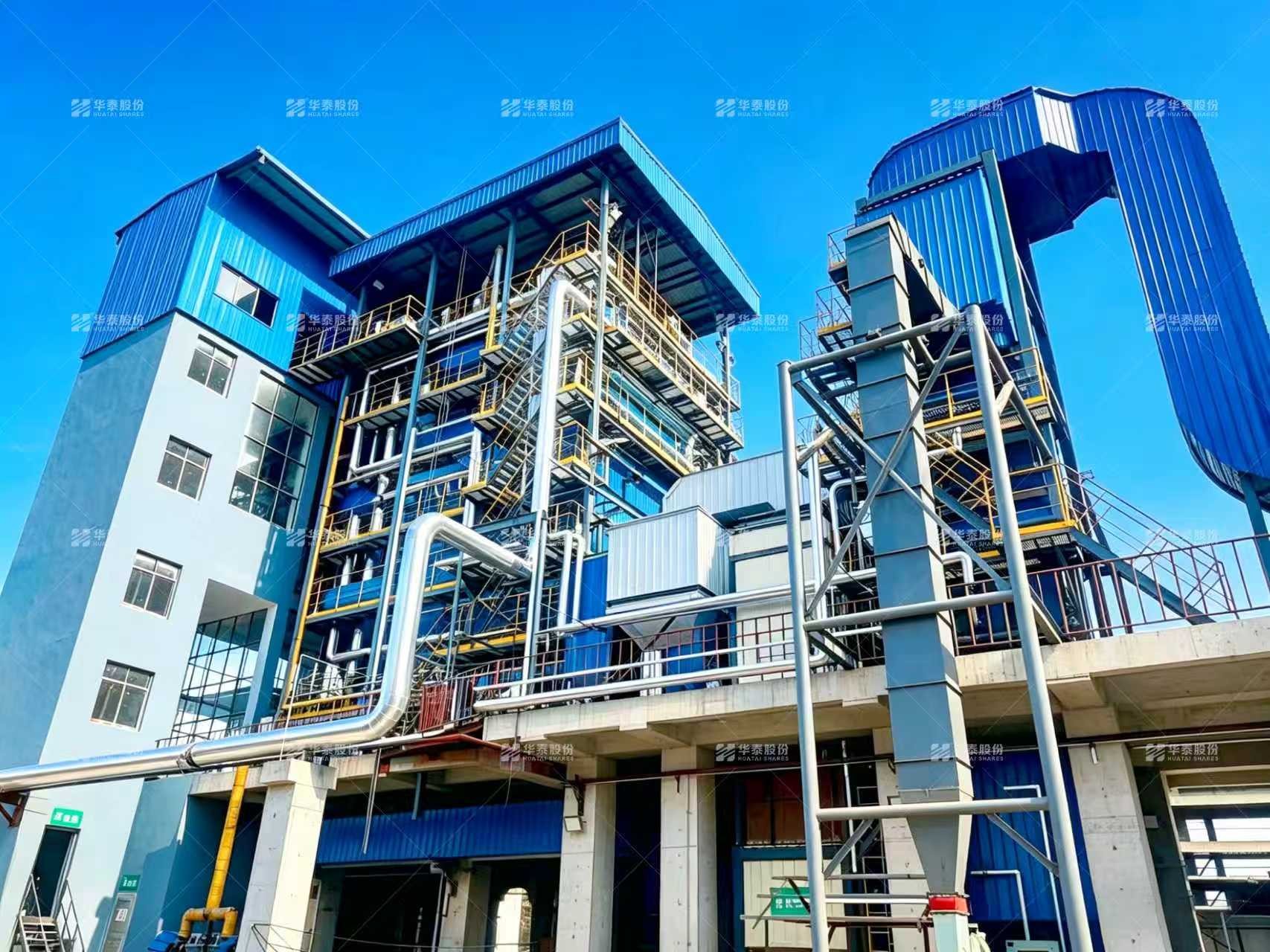
DHL Biomas Corner Tube Boiler: A pharmaceutical enterprise adopted a 20 t/h steam boiler. Precision pressure control ensures stable steam output to meet the strict temperature and pressure requirements of penicillin production lines.
SZL Biomass Boiler: A brewery selected a 15 t/h steam boiler during capacity expansion. It supports diversified fuels including biomass pellets, straw, wood blocks and palm kernel shells. The project is progressing smoothly.
DHW Biomass Corner Tube Boiler: This is a Huatai energy management project equipped with a 30 t/h boiler specially designed for furfural residue. Huatai undertakes investment, construction and operation of the boiler and environmental facilities. Our self-developed combustion technology adapts to high-moisture, low-calorific-value furfural residue for stable combustion, with flue gas meeting low-emission standards. Under the energy hosting model, the enterprise buys steam on demand without upfront construction investment, with 24/7 reliable steam supply.
If you are considering boiler retrofitting, fuel switching or new heating system construction, please share the following information with us:
Industry of your enterprise
Hourly or daily steam / hot water consumption
Current boiler type and fuel used
Local fuel supply conditions
Whether you face environmental rectification pressure
Huatai’s engineering team will evaluate your approximate energy-saving potential based on your actual conditions and provide targeted solution proposals.
Online chat Inquiry Let’s have a chat about boilers,Feel free to contact us.
 Tel: +86 18717921345
 Phone: +86 18717921345
 E-mail: ht@hnhtgf.com
 Add: 271 Huanghe Avenue, Xinxiang City,Henan Province, China


Copyright © 2026 Henan Huatai Petrochemical Equipment Co., Ltd